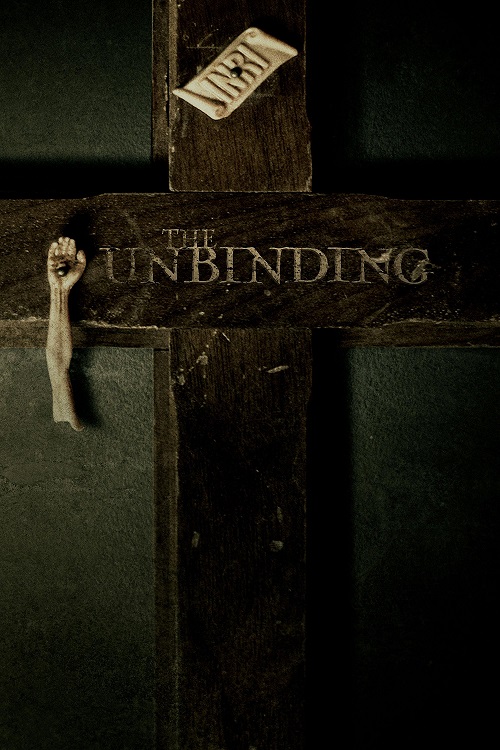
The Unbinding (Pfeiffer 2023) is a new documentary from the same team that brought us Hellier (Pfeiffer 2019). Because it’s so new, I shall avoid any spoilers in what follows.
The Unbinding (2023), directed by Karl Pfeiffer, “an archetypal journey […] to return an object that has much more to it than meets the eye”.
It concerns a weird-looking artefact that winds up in the possession of Greg and Dana Newkirk after its original discoverers undergo disturbing experiences and pass it to the Newkirks in desperation. Strange happenings then commence in the Newkirks’ home, so they begin a thorough magickal investigation. The story unfolds with all the narrative skill and high production values that fans of Hellier will be hoping for. In the film’s surprising conclusion, the nature of the artefact proves to be something that most viewers will never suspect.
From a magickal perspective The Unbinding raises some interesting questions: why would an entity of this nature behave like that; and is it significant that its story is being told at this historical moment? These questions are not explored in the film, and it still feels too soon for me to tackle them here, but what moved me to comment is a particular sequence that presents some difficulties concerning the ethics of occult content creation.
Of course, I create occult content too, and I’m ever conscious of the potential conflict between promotion of magickal or spiritual development and accumulation of an audience or revenue. I aim to produce content that’s clearly in the service of the former, but it’s not always an easy call.
Listeners to WORP FMwill have noticed our spasmodic recording schedule – algorithmic suicide, no doubt. Alan and I agree to make an episode far more often than we actually do. We make firm plans to talk about a topic but usually we decide that it isn’t really worthwhile. We’ll address something only when it seems to make a clear and constructive difference. If that sounds sanctimonious, so be it, but stating our conscious motive helps us try to live up to it, at least.
Magickal investigation in The Unbinding leads the participants to decide they must give up possession of the artefact. The Newkirks own and run a travelling museum of haunted objects; if they surrender the artefact it will no longer feature in the museum. They decide, as an experiment, to make a 3D digital scan of the artefact from which they can print a replica. Their stated aim is to explore whether a 3D print of a haunted object might also produce paranormal effects. Presumably, the replica will also fill the gap in the museum left by the original.
The sequence of the film in question was originally streamed live to internet followers. Whilst the artefact is being digitally scanned, questions are addressed to the spirit associated with it, and answers are obtained via a medium (who is wearing a blindfold and noise-cancelling headphones) using the Estes method.
The two operators begin by explaining their intentions to the spirit, but the medium’s responses immediately convey the spirit’s clear and fearful misgivings:
OPERATOR: A camera is going to send out little beams of light that are going to bounce off the artefact that you inhabit. MEDIUM: Choking. OPERATOR: It’s not going to hurt you. It’s not going to choke you. MEDIUM: It is. OPERATOR: It’s not going to hurt you, I promise […] MEDIUM: Hurt. OPERATOR: I promise, it’s not going to. (Pfeiffer 2023: 41’47”)
The scanning of the artefact begins and the medium reports sharp pains at specific points in her body. In an intercut sequence from a later interview, she states that never before had she experienced physical pain whilst using the Estes method.
The scanning process continues.
MEDIUM: Don’t… make that. OPERATOR: I have to. You don’t want us to print you? MEDIUM: No. No. OPERATOR: It’s almost done, sweetheart. (Pfeiffer 2023: 42’53”)
When a further scan is made the medium again reports physical pain.
The curious thing about this scene is that although the operators are palpably concerned for the spirit when (later) it seems it is being coerced and controlled by another entity, they seem oblivious to the possibility of distress caused by their own actions. Clearly, the spirit does not want the artefact to be scanned, and the reports from the medium suggest this is a cause of pain to the medium and/or the entity.
Rather than what the spirit says to them, the operators seem more impressed by the relevance and timing of the medium’s responses, as if dispelling doubt over the method or the veracity of the entity were a greater concern to them than the very clear request for them to stop. Possible reasons for that request are not explored either.
This scene impressed on me how even those of us who wholly accept the paranormal and magick are still vulnerable to slipping into materialistic thinking. Presumably unconsciously, the desire to obtain a replica of the artefact and to demonstrate the veracity of the method perhaps took precedence over understanding and responding to the communications as interactions with an actual presence.
Artefacts and methods that produce reliable effects are excellent resources for generating interesting content, but if the spirit’s “Don’t… make that” is to be heard and not drowned out, a magical perspective is required.
References
Pfeiffer, Karl, director (2019). Hellier. Planet Weird.
Pfeiffer, Karl, director (2023). The Unbinding. Planet Weird.
My working definition of awakening comes from my reading of Daniel Ingram’s Mastering the Core Teachings of the Buddha: the capacity for direct experience (in real time) of the non-dual nature of reality. However, in an old notebook of mine I came across a different definition from Christina Feldman, which she expressed during a ten-minute consultation at Gaia House.
“Awakening is the implosion of all samskaras,” she said.
I had forgotten this immediately. At the time it made no sense.
Samskaras are unconscious tendencies that influence perception. They determine how and of what we are conscious. The term samskara is often translated into English as “formation”. Fundamental human ignorance gives rise to samskaras and they, in turn, give rise to consciousness – that by means of which we are aware.
A samskara might be a karmic tendency formed in this lifetime, or it might arise from past lives. If that sounds fanciful, consider how these tendencies are neither conscious nor voluntary. Feasibly, they might arise from the influence of other people, which, in turn, arises from the influence of others upon them. In this sense samskaras very evidently reflect the impact of past lives.
Talking with Tommie Kelly about formations (in one of our forthcoming videos on the Nidana Cards) I realised I was out of my depth. When awakened teachers such as Ingram and Feldman talk about formations they are describing territory beyond my personal experience. Although, hopefully, I can give useful pointers to folks completely new to the concept, at best I’ve only caught some sketchy glimpses.
Tommie pointed me to a Daniel Ingram interview online, interesting because Daniel seems to delineate awakening there in a way that chimes more with Christina Feldman’s description. What we experience as personal intentions, he explains, are inseparable and no different from any other perception. It struck me that if reality were experienced directly in this way then formations would be seen clearly for what they are. Was this Feldman’s “implosion of all samskaras”?
Podcast interview in which Daniel Ingram seems to take a slightly different angle from usual in describing the experience of awakened consciousness. (See 5’16” onwards.)
So, I decided to explore intention in my daily meditation. I dedicated an hour simply to noting experiences that were preceded by an intention and those that weren’t.
Something very strange occurred.
I had been sitting for a while when my left hand began to move – not slightly, but vigorously, rotating side to side with a waggling motion of the wrist. It was a gesture that in a face-to-face conversation might have signified doubt or: “Hey, hold on there for a minute!” It lasted a couple of seconds. Then, another second later (and I felt immediately this was what the gesture had indicated) the timer sounded the end of the hour.
The weird thing, aside from its predicting precisely the end of the sit, was the lack of volition. My hand moved, but I was not moving it. Neither was it moved by an external force. The impetus to move was from within, but it wasn’t mine.
I had been sitting for almost an hour, carefully discriminating experiences that followed intentions from those that did not. Something seemed to want to show me what it knew would perplex me: a bodily movement with no intention, signifying a future event of which I had no knowledge. Even as I searched for the intention, my hand moved, and I was left looking on in wonder.
Where there is an intention we can say “I did that” and hang a sense of self on it. But, if an experience that’s usually preceded by an intention occurs without one, then an uncanny sense of “otherness” hangs on it instead. This feels anomalous, paranormal, distinctly “tricksterish”. Something seemed to indicate its sentience by signalling that it knew (or could predict) when the alarm was going to sound. It seemed as if something were aware that I was noting intentional and non-intentional experiences and had decided to throw at me one that was neither. Something seemed to demonstrate that it enjoys a relationship to consciousness and time very different from mine.
What came to mind, oddly, was the Pentagon UFO footage, GIMBAL and GOFAST. It had the same feeling: something displaying itself in ways it knows we cannot fit within our frame of reference.
Iconic video sequences of unidentified objects captured by US Navy fighter jets. (Left: “GIMBAL”. Right: “GOFAST”.)
A paranormal experience is a witnessing without understanding. Awakening is an understanding without witnessing. We do not see samskaras until we understand intention is inseparable from any other experience, an understanding that removes all notion of a witness. On awakening, reality appears the same but is understood. On witnessing the paranormal, reality feels perplexingly strange and different from what it seemed before.
Awakening dissolves the witness. Paranormal experience coagulates and isolates it. In response to what we don’t understand we may contract into fear, anger, or avoidance. People often encounter challenges on the path to awakening, anomalous experiences such as kundalini phenomena, unsolicited visions, or communications with discarnate entities. If these cause enough disruption to necessitate disclosure to medical professionals, they may attract a diagnosis of psychosis. The lack of an understanding of the experience is re-framed as a problem, a problem situated within the person seeking understanding rather than in what is not understood.
Fortunately, being human entails an ever-present possibility of understanding. The paranormal can be understood (paradoxically) as radically non-understandable. Then the focus shifts from questions about what a phenomenon “really is” onto our relationship with it. Then we can become a participant rather than a witness.
Our inability to comprehend the paranormal is not “in” us, it is us, because not understanding is the relationship of the human to the paranormal. It’s a samskara. Yet, once seen, it “implodes”.
We might choose to persist in trying to understand what the paranormal “is”, but it ought to give us pause for thought how, despite centuries of effort, we are no closer even to a definition of what we mean by “ghost”, “UFO”, or “faery”. We go on witnessing without understanding because this is our relationship to those phenomena.
It is tempting to wonder if the paranormal is designed to lead us away from comprehension. But that, again, is an attempt to define what it is. Taking this route are those accounts of the paranormal regarding it as “Satanic”. Certainly, paranormal experiences can deceive and mislead, but it depends on how the individual perceives them.
From the perspective of awakening, there is no witness separate from or looking onto reality, but simply reality understanding itself. This implies that the witness is an illusion, but so too is the sense of a separate “other” that creates a paranormal experience.
When my hand moved without conscious intention, it seemed that an intention (to make a signal) arose from something other. But if the experience of an intention is not the same as what expresses the intention then it is equally erroneous to mistake the absence of a personal intention for a paranormal other.
The more inexplicable an experience, the harder it is to discriminate between an event that was intended or (as the skeptic will always insist) an event that occurred naturally. It is mistaking the paranormal for an other that creates a sense of its separation from everyday reality.
Suppose a cup on the kitchen table flies across the room and shatters against the opposite wall. We might trace the cause to a natural phenomenon (a seismic tremor, perhaps) or, in the absence of any known natural cause, consider the paranormal option: the intention of some other. Opting for the latter confronts us with that quintessentially paranormal sense of something somehow operating outside of everyday reality. Yet, patently, if the cup were indeed flung at the intention of an other, the event and its instigator cannot be any less a part of reality than ourselves.
A paranormal experience is like an awakening in the way it confronts us with how intention is synonymous neither with self nor with other. It’s only when we understand the relationship between ourselves and the paranormal as defined by incomprehension that it ceases to appear as what it certainly cannot be: something unreal.
I was relieved, but then sensed where she was taking me, and I was filled with dread. Even as she held me, she showed me how everything would be taken away, and all that I feared most would happen.
She said: Though it all passes, I shall hold you.
I saw how the fullness of being held is the same as the emptiness of everything taken away.
She said: Held by me, emptiness is fullness. Emptiness and the loss of everything are held in the light of my perpetual embrace.
The slow, agonising death of postmodernism is one among many factors in our current cultural turmoil, but it has special relevance to chaos magick, which is founded so squarely on postmodernist thinking.
Since the far right also began embracing the notion that truth is relative, postmodernism is not looking quite so clever. This has placed chaos magick in a difficult position. The bad news was broken first by Gary Lachman, in his Dark Star Rising: Magick and Power in the Age of Trump. But there has been little discussion of this crisis from within chaos magick itself.
Having listened to a recent discussion on chaos magick between two eminent practitioners, Patricia MacCormack and Phil Hine, I wondered how the effects of this unaddressed crisis might continue to unfold in contemporary occultism.
Phil Hine and Patricia MacCormack, speaking at an event hosted by the Whitechapel Gallery, livestreamed on 18 September, 2021.
The notion of truth as relative has offered a reliable resistance to oppressive, absolutist “grand narratives”, and has been one of the great appeals of chaos magick. Phil Hine sets out bravely on this trusty steed, by describing how contemporary occultism has become constrained within a limiting dichotomy:
It’s either about bringing about a desired condition – money, love, sex, security – or it’s a transcendent trajectory towards a spiritual goal, whether that be union with a higher self, or a sense of divine participation, or even escaping from the materiality of existence. I think what binds those two trajectories together is the idea that magic has to be productive of something. It’s easy to see how both of those productions very quickly have become entangled with ideas of neoliberal governance. In fact, they are articulations of neoliberal ideology, if you like. (Whitechapel Gallery 2021: 45’32”)
Hine is highlighting the oppressive constraint of the neoliberalist paradigm, and showing how – because no paradigm has a greater claim to truth than any other – this is subvertable by exposing that it is merely a claim. Neoliberalism claims that only what is productive is valid, he shows us, but magick that is unproductive will escape from this.
So far, so good. But how do we subvert a paradigm that makes no claim to truth?
Increasingly, as the political right has commandeered postmodernism for its own ends, this is what we are facing. Donald Trump and Boris Johnson, for instance, cannot be subverted by exposing their lies, because they were never trying or even pretending to tell the truth in the first place. The chaos magical dictum “nothing is true; everything is permitted” suits them just fine. As it does Vladimir Putin, Jair Bolsonaro, and all the rest.
Lachman explores this problem in his distinction between “lying” and “bullshitting”:
Where the liar knows the truth and respects it – he does not want to get caught in his lie – the bullshitter couldn’t care less about it. He isn’t interested in the truth […] He is interested in the effect his bullshit has on his audience […] For chaos magick and postmodernism, whether something is true or false simply no longer matters. Truth or falsehood are beliefs which we can take on or put off as need be. (Lachman, 2018: 75)
Neoliberalism, unfortunately, is postmodern. It is bullshit. So it cannot be subverted by pointing out that its claims to truth are lies, because it makes no such claims.
Neoliberalist capitalism is now widely accepted as the only system that can work (Fisher 2009). Consequently, it does not need to make a case for itself. It does not matter what kind of impact it has, because there is no alternative.
Neoliberalism is much younger than the exhortation to productivity that Hine defines it as. (For example, the far-older “protestant work ethic” fits this definition just as well.) The chief characteristic of neoliberalism is its concession of authority to the market rather than to human ideals. When it is supposed that there is no such thing as truth, then all human ideals are merely competing narratives, none truer than another – in which case, why shouldn’t the market decide? When the principle of “nothing is true; everything is permitted” falls into the hands of right-wing demagogues, this is the type of result we can expect.
Within an economy determined by markets rather than by human need, neoliberalism, to ensure our compliance, engages and distracts us into a project of constant adaptation and self-improvement (Han 2017).
I recently left a job where I was providing assessments and counselling within a national employee assistance scheme. I was struck by the frequency with which employees described bad working conditions but had come seeking therapy or (more usually) medication, because they regarded themselves as the problem. Neoliberalism is hugely successful at persuading us the only viable reality is one organised according to market forces rather than by human ideals, and that it is our own responsibility to either adapt to this, or else consider ourselves failures.
“[S]elf-government and self-management are the pre-eminent political messages”, writes the psychoanalyst Paul Verhaeghe:
[T]he freedom we perceive ourselves as having in the west is the greatest untruth of this day and age. […] We are indeed freer than before, in the sense that we can criticise religion, take advantage of the new laissez-faire attitude to sex and support any political movement we like. We can do all these things because they no longer have any significance […] our daily lives have become a constant battle against a bureaucracy that would make Kafka weak at the knees. (Verhaeghe 2014)
Hine suggests that magick which resists neoliberalism should avoid productivity and purpose, and cultivate instead a sense of wonder.
It can be as simple as the joy you feel in your heart when you see a friend on the street you haven’t seen for years, or just becoming lost in the in the play of the sunlight on a puddle […] That mode of perception itself creates a kind of occult artistic practice where all things can be magical […] the desire and delight in perceiving in a magical way. (Whitechapel Gallery 2021: 51’06”)
When we are forced into constant productivity then, indeed, non-productivity might look like a form of resistance. But exposing how the real aim of neoliberalism is only to extract productivity from us does not pull out the rug from under it, because neoliberalism does not pretend otherwise. It is postmodern. It does not insist on market forces because it regards these as either good or true, but just because it can. It does not hide any lies from us; it is pure bullshit.
There is nothing wrong with finding rapture in a puddle. Unless we have been forced into it, and under the inhuman pressures of neoliberalism have lost all hope of either goodness or truth.
Rather than renouncing productivity, another form of resistance might be to hijack the resources of neoliberalism for production that serves our own ends. This might be through magick, or more quotidian forms of causation – although to avoid unwanted attention magick might be the better option. The aim would be results, but for our own purposes, not in the service of market forces. Recent examples that spring to mind are the videos posted online by Shana Ragland and Beth McGrath, both former Walmart employees who used their employer’s public address system to air their grievances. Hine himself describes how he once placed a spurious sign in the executive restroom of a company where he worked, enjoying the chaos that ensued (Whitechapel Gallery 2021: 88’25”).
Beth McGrath: “Everyone here is overworked and underpaid… Fuck management and fuck this job! I quit!”
Sadly, chaos magick that previously worked well is no longer likely to do so against oppressive ideologies that are themselves postmodern.
During their livestreamed conversation, it was pointed out to MacCormack and Hine that their suggestion that magick should be purposeless is, of course, paradoxically ascribing a purpose to magick. (“Nothing is true” has always been, in itself, a claim to absolute truth.) Hine accepts that complete purposelessness may be impossible, but describes what, for him, comes closest to this.
I do a lot of – if you like – devotional practice to a particular goddess, and the whole idea of these practices is to dissolve that sense of distinction between you and the divine. So, I’ll often attempt to feel that goddess’s presence in my body and in the world around me. And that is a very weak purpose. Rather than saying: “I’m invoking this goddess in order that she might interfere with my continual fight to get the roof fixed”, the purpose is: “I want to experience the divine presence of the goddess”, which I think is a lot looser purpose. (Whitechapel Gallery 2021: 98’01”)
Having rejected results-based and transcendental forms of magick as both constrained by a neoliberalist notion of productivity, in the end Hine chooses the transcendental as his least worst option. Not because he regards it as better or more true, but because he seems to regard it as simply the least purposeful option.
But I wonder if this might not be what it seems. I wonder if actually Hine takes refuge in the goddess not because she is his least purposeful option, but the truest and the best. If this were true – or even if it were false – then it would then have a definite relationship to the truth. And in that case, it would certainly not be bullshit, although it would mean abandonment of postmodernism.
I recently read and enjoyed John Michael Greer’s The King in Orange: The Magical and Occult Roots of Political Power (2021). Comparisons are likely be made with Gary Lachman’s Dark Star Rising: Magick and Power in the Age of Trump (2018), a book that I’ve mentioned previously. Both examine the magickal aspects of Trump’s election to US President, but from very different perspectives. Lachman might be said to have written more on the political dimension of magick, whereas Greer addresses the magical dimension of politics. Lachman’s book is more academic. Greer’s, with its forays into aeonics and prophecy, is clearly slanted towards occultists.
Greer warns us at the outset “this book won’t be easy reading” (Greer 2021: 9) because to understand the rise of Trump it is necessary to confront issues of class prejudice that both liberals and conservatives have done their best to render unsayable. In reader reviews on Amazon and Goodreads, Greer has provoked indignation for supposed pro-Trumpism. I think this is too simplistic. It seems to me that Greer has no great love specifically for The Donald:
[A] brash and blustering New York real estate mogul who’d taken up a second career as a wrestling promoter and a third as a reality television star […] someone was going to do it sooner or later. Trump happened to be the person who got swept up in this particular tide and carried by it to an improbable destiny. (Greer 2021: 170)
Greer does not tell us who he voted for in 2016, but he does state that he voted (Greer 2021: 12). My guess would be that he voted for Trump. Personally, I could never have done that, but if Greer did then it was with the best intentions:
Cratering wages and soaring rents, a legal environment that increasingly denies even basic rights to everybody but corporations and the rich, an economy rigged to load ever-increasing costs on working people while funneling all the benefits to those who already have too much […] If you don’t happen to belong to the privileged classes, life in today’s America is rapidly becoming intolerable (Greer 2021: 25-6)
Not many Trump enthusiasts would argue, as Greer does, that the Democrats idiotically rigged their own nomination process to exclude Bernie Sanders, and that – had he been allowed to stand – Sanders would have won (Greer 2021: 17). In fact, I am not sure I can share Greer’s faith in that, having witnessed in the UK the outcome of Jeremy Corbyn’s 2019 General Election campaign, which demonstrated, yet again, the enduring determination of turkeys to vote for Christmas.
Greer attributes Trump’s rise to the class conflict between the “wage class” and “salaried class”, tracing the deep origins of this split in the geography and history of the US. I suspect that he uses these terms rather than “working class” and “middle class” to make his analysis sound a little less Marxist than it actually is. Where Greer certainly departs from Marxism, however, is in his scepticism that class struggle leads inevitably or justifiably to “an orgy of revolutionary violence” (Greer 2021: 63).
Greer has identified himself as a Burkean conservative, influenced by the writings of the political philosopher Edmund Burke (1729-1797). “[W]hen human beings try to set up a system of government based on abstract principles, rather than allowing it to take shape organically out of historical experience”, Greer asserts, “the results will pretty reliably be disastrous” (Greer 2016). This grounded and pragmatic perspective originates from Burke’s ideas on how the high ideals that propelled the French Revolution of 1789 nevertheless led to appalling outcomes.
Searching inside myself, this is not a perspective I share. The English Civil War (1642-1651) is a period that fascinates me, because I always felt a strong affinity with the Parliamentarian side. Had I been on the scene, no doubt I could not have resisted supporting that monumental decision to execute the king. Even though this had no historical precedent, and the consequences were not foreseeable – although it must have been apparent they could be dire (as, indeed, Cromwell’s rule turned out to be) – I could not have passed up such a unique opportunity to destroy a tyrant and enter into something utterly new. I am not necessarily proud of this, but I know what I am like, and considering the many other revolutionary debacles of history, it seems plenty of others share this trait.
Greer, with disarming honesty, outlines some of his own affiliations. He describes the predicament of those denied membership of the salaried class: “a familiar subculture for me, not least because I belong to it: a great many occultists these days do” (Greer 2021: 93-4).
How would a vote for Trump square with Burkean conservatism? Caution, compromise, stability, the safeguarding of proven institutions – Trump neither promised nor delivered any of these. Greer highlights similarities between Trump and Julius Caesar: both wealthy aristocrats who bypassed their political class and appealed directly to the masses (Greer 2021: 31). Is this the basis of a Burkean apology for Trump – that being a modern Caesar makes him a known, dependable entity?
I would suggest that maybe the supposed “abstract principles” that revolutionary political systems have been founded upon are, in truth, nowhere near abstract enough. Surely, rights and ideals are notions born of human suffering and of history, just like any other notion. Revolution, therefore, is not necessarily a metaphysical delusion. It, too, is an ancestral bequest. I suspect no one seriously believes they are obeying a metaphysical imperative if they relieve Charles I and Louis XVI of their heads, or stick it to the Democrats by voting for Trump. We do these things because – honestly and humanly – we hope it will make us feel better.
Pepe the Frog.
The consequences of the French Revolution appeared horrendous to Burke in the 1790s. They seemed horrendous still to Margaret Thatcher at its bicentenary (Johnson 1989). In her comments, she pretty much channelled the ghost of Burke. But her views on the revolution were in the minority by then and widely criticised. How (and when) can we ever judge an action from “historical experience” when, evidently, the meaning of this shifts radically over time?
We are powerless to be anything other than human, but does this mean that to be human is to be powerless?
This is a question that perhaps haunts The King in Orange, and maybe Greer’s writing and approach to magick in general. He rejects the contemporary view that magick originates in the conscious choices of human beings. Instead, a proficient magician will aim to “trim their sails accordingly and not waste time and effort trying to sail into the teeth of a rising gale” (Greer 2021: 126). For Greer, the fledgling chaotes whose meme magick conjured Trump into office were ignorant of this, “swept up in something over which they had no control at all. The shortest description of 2016 is that that’s what happened” (Greer 2021: 101).
His fascination with the Lovecraftian mythos seems to provide an arena for these themes. Greer has created an entire cycle of Lovecraft-inspired novels in which the elder gods, monsters, and their human adherents are actually the good guys: “just one more religious minority targeted by hateful propaganda and violent persecution” (Greer 2021: 7). This inversion suggests it is alliance with the non-human that offers salvation, in contrast to the “crazed rationalists” of the other side, fomenting a human-driven ecological collapse.
For Lovecraft, the other was horrific, yet all too real and alive. But what is terrifying to Greer, it seems, is the rigid, bloodless deathliness that arises from a wilful exclusion of the other. The pallid revolutionary renounces the non-human, without recognising that this severs their connection to the basis of human life. Unlike Lovecraft, an unusual presence is a lesser horror to Greer than familiar absence.
Personally, I am not convinced that building the New Jerusalem necessarily follows this trajectory. But from the perspective Greer takes, maybe it becomes understandable how the overt awfulness of Trump might seem to command a greater appeal than the righteous nastiness of the lesser evil.
An unusual presence trumps a familiar absence.
References
John Michael Greer (2021). The King in Orange: The Magical and Occult Roots of Political Power. Rochester, VT: Inner Traditions.
John Michael Greer (2016). A Few Notes on Burkean Conservatism, https://tinyurl.com/3vnrmrzz (resilience.org). Accessed October 2021.
Maureen Johnson (1989). Thatcher Remarks Renew France and Britain Rivalry, https://tinyurl.com/yuuennhn (apnews.com). Accessed October 2021.
Gary Lachman (2018). Dark Star Rising: Magick and Power in the Age of Trump. New York: TarcherPerigree.
“Is it right and permissible to ask you to end the lives of our enemies?” I asked the archangel Azrael. “Is contact with you likely to provide any benefit?”
Random thoughts flickered through my mind, mostly concerned with the events and coincidences that had raised these questions and brought me down to the shed before daybreak to invoke the angel.
The seal of the archangel Azrael.
Firstly, my dream from the previous night: wandering with two long-lost friends through streets we knew but which were now much-changed, each of us wondering if we were dreaming. Then I said: “I think only I am dreaming, and your thinking you are dreaming is only my dream.”
And then my dream from the night before that: I had become obsessed with compiling a playlist of songs from the eighties. It was so vivid that the next day I set about compiling the same list of tracks whilst awake – and, yes, I quickly became obsessed, because the tracks were diverse and I could not find an ordering that provided pleasant-sounding transitions.
Next, the so-called “27 Club”: musicians and artists who had died tragically at the age of twenty-seven, including Jimi Hendrix, Janis Joplin, Jim Morrison, and Kurt Cobain.
Then the intriguing intersection of musical inspiration and the angelic in novels by David Keenan. (“For Azrael is the angel described in these works”, Azrael told me.)
And finally, the first appearance of Azrael months ago. A friend was troubled by shadow entities in her home and our group offered to exorcise them using a scrying process, calling on the archangel Raphael, which had worked well for us in two previous and similar cases.
When the shadow entities appeared the word “Azrael” occurred spontaneously to my friend, although she did not consciously recognise its meaning.
Three of us undertook the working, over a video connection, and we were shocked by the negative consequences. I escaped relatively lightly, experiencing only a nasty sulphurous smell. My colleague found himself in sudden physical pain, feeling a sense of dread that lingered over several days, and there were unexplained scratching noises and footsteps in his home, which his partner also heard.
Azrael showed me how all these were connected, because Azrael had connected and completed them by being invoked.
Azrael showed itself to me as a crystalline structure embracing all living beings across all dimensions, the function of which is to bring each being to completion as a living being. Completion is the key to understanding Azrael.
In the present time, many people are calling out to Azrael because they feel loss. In my social circle at the moment, many are angry at the corruption of politicians who no longer represent the people to power but now represent the interests of power towards the people. The politicians pretend that significant change is not possible, and they pretend at patriotism (to ensure support) even as they sell off our nation’s assets to benefit themselves and the power they represent.
A rash of flags. If they think it garners them votes then they do not seem to mind looking like fascists.
The ballot box apparently cannot rid us of them – but can magick? It is a dark thought, but consider: there would be no material or causal connection between an assassin and a target if the means of assassination were magick. Yet this could never be undertaken lightly, because it would place a person in the very same position ethically as if physical measures had been taken. The karmic consequences would be dire, yet there is the option to recognise and own the consequences. Was Azrael showing up now because this was viable?
We made a divination for further guidance. “Is it permissible”, we asked, “to request an angel to eliminate someone whom that angel recognises as a malefactor?”
From the tarot came Five of Wands, Six of Pentacles inverted, and the Knight of Cups inverted. From the I Ching came Hexagram Thirty, The Clinging, Fire. With a moving sixth line, this was transitioning to Hexagram Fifty-Five, Abundance. We picked our jaws up off the floor after reading the meaning of that moving sixth line:
It is best to kill the leaders (Anthony 1988: 144).
But let us take a pause.
It would have been easy to read this as complicit assurance, rather than the wry pun it actually was. The correct way to read the I Ching is always as the advice of an immeasurably enlightened being.
If Azrael brings down upon all living beings not only grisly demise but completion, then things are not so simple. I was crying out from a place of loss. Maybe, dear reader, at this moment in time you are too. In this state is it wise for living beings to call down completion on either themselves or others? Consider the 27 Club – their works and reputations are preserved in beauty forever by the tragic and premature completion of lives. But how does this mitigate the losses they endured in life, and the loss of their lives to the rest of the world?
Azrael brings all beings to perfect completion, but the completion of being is not resolution of loss nor the restoration of losses.
In my dream I woke to the truth that I was dreaming, and so the dream ended and was complete. But only whilst sleeping were my lost friends restored. On completion of the dream they were lost again.
And in my other dream, the songs on the eighties playlist are available in the present, but there is no hope of imposing any tidy completion upon their diversity, their chaotic jumble of sounds. It would be obsession to attempt this, whereas in refraining from obsession there might be joy.
To call down Azrael upon vicious liars and thieves is to complete them as such. They become a maleficent version of the 27 Club. The meaning of Hexagram Fifty-Five, Abundance, is the recognition that when we lack influence upon others we must let go of seeking it: “to hold to the power of truth is to overcome all darkening trends” (Anthony 1988: 251).
“It is best to kill the leaders”, urged that moving sixth line in Hexagram Thirty, The Clinging, Fire. But who are those leaders?
The most evil ringleaders of disorder in the personality are vanity and pride – the ego, whether it is self-depreciating, self-congratulating, or self-defending (Anthony 1988: 144).
Hexagram Thirty is a chastening reminder of the obvious.
When events seem foreboding and people seem evil, we should remember the good that was and still has potential in them. The more evil they seem to be, the more resolutely we must cling to that potential. If we cling to the invisible sparks of light that are eclipsed by their inferior natures, the power of clinging will enable the dark force to be overcome. (Anthony 1988: 141)
When is it inadvisable to pursue goodness and truth? Never. Obviously. But in the grip of loss this may become obscured.
[D]esire and impatience […] have their origins in fear and doubt. Vanity is also present when we see ourselves as rejected, alone, abandoned. Vanity causes us to want “inside knowledge”, to have a “handle” on things, and to seek assurances that will work to our satisfaction. Vanity […] makes us think that everything in life is dependent on human decisions; it causes us to forget that the Cosmos is at work putting things to right, and that we are not required to accomplish everything by ourselves. (Anthony 1988: 145)
I had been looking to magick to provide the “handle”, the “inside knowledge”.
The lessons of the hexagrams were underscored by the tarot: Five of Wands indicates discord and struggle; Six of Pentacles, inverted, suggests greed and corruption. The Knight of Cups is associated with Sir Perceval, he who seeks the Holy Grail, but the card is inverted, signifying a failure at or deviation from the quest. So the first card of these three hints at incompletion and irresolution, and the others point at abandonment and loss.
Azrael can take nothing away. By dying no being attains or achieves anything except completion of its life. On this side of existence, completion is what Azrael has to offer. Whatever remains unresolved must find its solution after death.
Azrael, the archangel of death.
David Keenan’s novel This is Memorial Device (2018) is the fictional history of a band formed in the early eighties from the post-punk scene in Airdrie, as told by various characters who encounter the band members and their music. The bassist is Remy Farr, and one of the chapters concerns his father. Remy’s father wrote a tract that argued “there was some kind of disjunction between actions and thoughts. It wasn’t that they were parallel occurrences, in his view actions were eternal and forever but thought was something that happened in time and that came to pass only once” (Keenan 2018: 62).
Remy’s father describes being on holiday with his wife, kneeling down to clean some plates after a meal at a picnic spot, when he notices two small indentations in the grass into which his knees fit perfectly. He is convinced that he created these holes himself, because he is re-living his life repeatedly rather than it unfolding uniquely through time, “as though his secret self (his guardian angel he called it) had constructed this total artwork that had lain in wait for him (or more properly that had always existed and that was now somehow revealing itself to thought)” (Keenan 2018: 63-4).
If actions are fixed forever, but thoughts come only once, then – Remy’s father reasons – life is “this precise set of occurrences” (Keenan 2018: 64) and our thoughts are judgments upon it. He takes this a couple of steps further. First, if we ourselves (or an angel) has set up everything that happens in our life, “then what thought demands of us is nothing less than that we weigh the will of God itself” (Keenan 2018: 64). Second, he suggests a possible transcendence: if we refuse our gift of judgment and the will of God then could it be that “the whole thing comes full circle and finally you are able to live your life as written (in history and in time over again), but this time outside of mind, without judgment and beyond understanding?” (Keenan 2018: 65).
There is no longer a sense of a passage through life, of life unfolding through time or mind, demanding to be understood and judged, but the cessation of a need for mind, judgment, or understanding as conditions of the unfolding of life. This is no longer, then, the setting up of the circumstances of life by the guardian angel, but maybe something like the completion of life that Azrael brings. The completion of life is when God’s will offers us nothing further.
Keenan’s Xstabeth (2020) is about another father – the father of the narrator, Aneliya – an aging but commercially naïve musician who, after a disillusioned break, decides to return to performance. His music is improvised and, although he does not record the performance, mysteriously a recording appears under the name “Xstabeth”: “he both recognised it as himself whilst thinking that the voice was coming from someone else entirely” (Keenan 2020: 56). Aneliya’s father is distraught when a second album appears without him having given any further performances. Xstabeth is some kind of an emerging entity, maybe an angel, perhaps a saint. After a subsequent performance, Aneliya’s father vanishes.
Is Keenan returning to the insights of Remy’s father in this later novel? Xstabeth seems a narrative elaboration of a process by which our actions, through assuming a life of their own, transcend the conditions of our lived being.
He had come through art. I realised. Was what he said. Or he might have said. I am realised. […] The point of art is to be done with it. He said. […] The point of art is to get you to the place where you have no need of it. […] The end of art is at the end of the world. (Keenan 2020: 62-3)
“For I am the angel described in these works”, Azrael assured me.
Music is a recurring motif in this nexus of concepts. I was reminded of a brilliantly incisive conversation on the intrinsic weirdness of music between J.F. Martel and Phil Ford.
Music is regarded as the most abstract artform, yet also the most direct in how it represents nothing to us figuratively yet exerts a direct effect: “You don’t just entertain a notion of sadness”, Phil Ford commented. “You feel it. It takes you over. You become a different person when you listen to sad music” (14’29”). On listening to music, the listener becomes the music. It makes us into what it evokes. J.F. Martel draws out the philosophical implications of this: “The things that we think exist only in our heads are already out there. That’s what music teaches me” (17’52”).
Perhaps all art forms achieve this, but in different ways. And maybe it is not just art, but every action, every karmic impression. In music it is clearest how actions (those minute vibrations of molecules through air) have a life and meaning that eclipses those we usually perceive as being our own. Azrael is the spiritual being that that fulfils this function to its fullest and at its final extent.
The shadow entities witnessed by my friend followed a bereavement of someone who had endured much pain and loss. In retrospect the emergence of the name “Azrael” may have been an indication that completion would have been a better approach than an attempt at healing.
The dead are beyond suffering. It would be a misconstrual to suppose the consequences of our working impacted on anyone other than ourselves. Healing involves an encounter with the other’s pain, and that was maybe what had impacted on us.
The problem here is more subtle than knowing the right angel to evoke. Through contact with and contemplation of these spiritual beings the work actually lies in developing an understanding of how karma operates in the context of being, dying, pain, ignorance, and loss.
I hope that the I Ching and the tarot and finally the invocation of Azrael itself have now furnished a fuller understanding and have cleared the way.
References
Anthony, Carol K. (1988). A Guide to the I Ching, third edition. Stow, MA: Anthony Publishing.
Ford, Phil & J.F. Martel (2020) Weird studies episode 90 – “The Owl in Daylight”: on Philip K. Dick’s unwritten masterpiece. https://tinyurl.com/wsdus8yp (weirdstudies.com). Accessed March 2021.
Sounds more like mysticism than magick? Well, it applies equally to sorcery. Suppose we evoke a demon to obtain the perfect chalice for our altar. The result arrives by experiencing the truth of the demon having sourced the chalice for us. (We could have just searched for a nice chalice online, but instead we gave ourselves an actual experience of a demon finding it for us.)
Having recognised that magick is the experience of truth, we may then want to refine this into more direct and simpler forms of truth.
So: what is truth?
Its hallmarks are inclusivity, wholeness, unity.
A popular notion of truth is of a correspondence between an idea and a state of affairs. That is, the unity of the idea and the state of affairs. Unity is what is engineered in an act of sorcery: the synchronicity between intention and an outcome. What is omitted from the “correspondence” model of truth, however, is truth that cannot be formulated in an idea or does not depend upon a human being thinking something: in other words, truth that might be described as absolute or eternal.
The truer something is, the more it can incorporate and the less that falls outside of it. Of course, this is a very poor way to think of it because – evidently – it would be even truer to include also whatever is not a thing and also whatever fails to include anything.
Ultimate truth is that which includes everything. Platonists called it “The One”. The One is so utterly damn inclusive it even includes what is not itself – that is, the Many. In a non-dual experience this is what becomes apparent: our individual experience is the Divine yet – at the same time – only a part of the Divine.
“Avoid monism. It is lazy,” suggests Douglas Batchelor (2020: 37’32”), advocating animism as a better approach: “everything is conscious” (Batchelor 2020: 37’52”). An alternative, then, would be that there is not one consciousness in which everything participates, but everything has a separate consciousness.
The problem with animism is what constitutes an entity. If a tree has consciousness, then how about its branches, twigs and leafs? What about the molecules in the tree? How about its atoms? Do these all have separate consciousnesses? If not, then it is false that everything has a separate consciousness; if so, then how is the tree an entity when its parts are different from it?
With the One and a hierarchical relationship between the One and the Many, Platonism offers a theory of participation that makes sense of this. The Platonic Academy endured for hundreds of years, attracting great minds, so it seems unlikely that its doctrine is truly “lazy”.
What does seem lazy is the notion there is no such thing as truth. After nearly thirty years I went back to university for my therapeutic training, enduring the same postmodernist nonsense that had been there in the 1980s. But the lecturers were now the same age as myself. “Haven’t you found a way out of that crap?” I wondered.
However, the idea that nothing is true, or that no idea has a greater claim to truth than any other, is indeed more true (because it includes more) than the idea that only a certain thing is true. Postmodernism was more inclusive than the metanarratives that preceded it, which insisted on only a certain way of seeing the world as true. If truth is gold, then postmodernism discovered gold everywhere, but simultaneously put it at risk of being valued as worthless.
Postmodernism had evidently hit the buffers when the likes of Trump and Putin could clearly be seen appropriating its relativism to achieve their ends. Suddenly truth was back in fashion among liberals who had previously championed postmodernism: “Truth is more important now than ever” was the slogan of an anti-Trump New York Times campaign (New York Times 2017).
The current culture wars are due partly to the attenuated death throes of postmodernism. It is perhaps easier to imagine we are now “post-truth” (which is really just more moribund postmodernism) than to ditch the correspondence conception of truth and move towards an inclusivity model. Magick, which offers methods for the direct experience of truth, could have an important role in a progressive response to the crisis. But the magickal community is, of course, riven by the same tensions afflicting wider culture. Many are responding by clinging to either postmodernism or traditionalism.
The inclusivity model implies that all participate in truth, but not equally. Participation is increased by including more of what has been omitted. An example of these dynamics is presented by Alex Tsakiris, host of the Skeptiko podcast.
In almost every episode, Tsakiris challenges the secular materialist paradigm of human beings as “biological robots in a meaningless universe [for whom] there cannot be a moral good or bad” (Tsakiris 2021: 11’48”). For Tsakiris, materialist science wilfully ignores contrary evidence (such as near-death experience), and is so nonsensical that its dominance must indicate some kind of hidden agenda: “Science, as we know it, is best understood from a conspiratorial framework” (Tsakiris 2021: 52’16”), he suggests.
But consider the secular materialist view in comparison to the non-dual experience: Do we have a sense of individual free will within the non-dual experience? Is there still a sense of being a human individual? Is the non-dual experience helpfully describable as good, bad, or meaningful? Approached from this direction, perhaps secular materialism and the non-dual experience are less far apart. As a description of reality, secular materialism maybe does not do so badly. It is perhaps an honest attempt to transcend the ego by highlighting how small and insignificant it is on a cosmic scale. But it performs this badly, because what it omits is any relationship between reality and individual consciousness. The relationship is one of participation. In contrast, the non-dual experience is that direct participation.
To assert that there is such a thing as truth, and that it is the very same truth for all, is neither reductive nor fundamentalist, because the One includes the Many through participation. This is not to say that truth is never wilfully refused, resisted, or perverted, but it does mean it is never escaped from entirely. We participate inescapably to some degree, like the postmodernist who claims “there is no truth” which, of course, is a truth claim. We leak truth even in our refusal of it.
If there were no truth no one would bother getting out of bed. Indeed, all it takes to hinder us from getting up is the feeling or suspicion that there is no truth – it instantly puts paid to any sense of pleasure or a point to life. But by offering the means for experiencing truth, for changing our relationship to it and our participation in it, magick can be an antidote.
References
Batchelor, Douglas (2020). What magic is this? Neoplatonism. https://tinyurl.com/t4o1dkrv (whatmagicisthis.com). Accessed February, 2021.
New York Times (2017). The New York Times has a new marketing campaign. https://tinyurl.com/spqsoe6q (facebook.com). Accessed February, 2021.
Tsakiris, Alex (2021). Skeptiko #486. Curt Jaimungal, Better Left Unsaid analysis. https://tinyurl.com/16y420vt (skeptiko.com). Accessed February, 2021.
Recently I was meditating. After a lengthy spell of practising concentration upon the breath, I have decided to return to vipassana.
There was a sense of something – a roughly cylindrical object made of flesh or plant matter. My sense was that although this might slowly decay, it would never quite dissipate. A story started up in my mind about how I would never be free from it. But instead of buying into this, I included the arising of the story into my investigation of my current experience. This felt like an effort, and resentment against the effort arose, and another story started up about it not being right that this should feel so effortful. But again, I included the arising of the story into my awareness of what I was experiencing.
Then – wham. It all released. Suddenly, shockingly, the cylindrical thing was gone. It was all gone and never had been. There was a sudden and total silence of the mind in which nothing needed to happen and never had or could.
The impermanence door aspect relates to realizing what is “between the frames” of the sensate universe […] and it tends to have a dat.dat.dat-gone! quality to it, as if all of space has stuttered three or four times in very rapid succession (about a quarter of a second or less for the whole thing) and disappeared. It is the fastest of the three and tends to be the most surprising. (Ingram 2018: 260-1)
Some of the most perplexing passages of Daniel Ingram’s Mastering the Core Teachings of the Buddha (2018) are in the sections in which he describes fruition. Only gradually have I felt able to apply these to my own experience. What I have described above was a fruition through the door of impermanence. It is the first time I have managed to recognise one of these as such.
For readers unfamiliar with Ingram’s work, here is a brutal introduction: Daniel claims the status of an arahat (a term from the Therevadan Buddhist tradition applied to a fully awakened person) and provides specific descriptions of maps and practices through which the reader can replicate his attainment for themselves. Because of its strong emphasis on method, his work has found an interested audience in the occult community and among those involved in contemplative science research.
Central to Daniel’s description of how awakening occurs are the stages of insight: a cyclical sequence of changes in awareness that produces a deepening understanding of what reality truly is. Mastering the Core Teachings of the Buddha describes how this sequence is traversed in meditation, how to facilitate the process, and thereby how to move towards awakening.
Fruition is the climactic stage in the insight cycle that I would attempt to describe as when the meditator’s awareness and reality synchronise for an indescribable instant. As Daniel describes it: “‘Reality’ stops cold and then reappears” (Ingram 2018: 256). In fruition, self-awareness vanishes because the illusion of self drops away, yet the prelude to it can take various distinct forms, which Daniel describes (metaphorically) as determined by entry through one of three possible “doors”: impermanence, suffering, or no-self. These, in Buddhism, are also known as “the three characteristics”. They are qualities found in each and every sensory and non-sensory experience and so, as such, are the bedrock attributes of what presents itself as “reality”.
All of this may sound very obscure, but the aim of vipassana is to refine our observation of experience to a degree where we can start to see some of this for ourselves, in our own way, and to the best of our ability.
Daniel has a gift for phenomenology, a disconcerting talent for unflinchingly and directly grasping the complex minutiae of experience exactly as they are with a minimum of storytelling or interpretation. For instance, regarding another, specific type of fruition he writes:
The rarest no-self/suffering variant is hard to describe, and involves reality becoming like a doughnut whose whole outer edge rotates inwards such as to trade places with its inner edge (the edge that made the hole in the middle) that rotates to the outer edge position, and when they trade places reality vanishes. The spinning includes the whole background of space in all directions. Fruition occurs when the two have switched places and the whole thing vanishes. (Ingram 2018: 262)
However, as a friend and fellow vipassana practitioner sceptically remarked: Whilst meditating I have never ever seen a fucking doughnut!
It has taken me a long time to understand how Daniel’s descriptions of fruition can be helpful, even if they do not match my experience. In the moment before a fruition I often experience a vision. These are like waking dreams in which I seem transported into a completely different place. You do not need a vision to have a fruition; I just seem to have the type of mind that does this. My very first fruition I described in The Blood of the Saints:
I was outside a dark doorway in a hot, desert country. I was there to interview [Primal Awareness]. He was waiting inside. But then I simply realised that Primal Awareness and I were the same thing. There was no need for an interview; I would only be interviewing myself. I had nothing to do, nowhere to go; there was bliss and hilarity. It was obvious that awareness had nothing to do with “me”, because “all this” was already “it”. (Chapman & Barford 2009: 137)
I did not recognise it at the time, but this was a fruition through the door of no-self. Compare my vision with Daniel’s barer, more functional description:
It relates to observing directly the collapse of the illusion of duality, the collapse of awareness into the intelligence or cognition of the perceived. It is a bit like staring back at yourself (or something intelligent regardless of whether it looks like you) with no one on this side to be stared at and then collapsing into that image. […] The no-self door is the opposite of the suffering door, in that everything comes this way (rather than everything going that way). The no-self door aspect tends to be the most pleasant, easy, and visually interesting of the three. It is slightly slower than the others, maybe a half of a second for all three to four moments of it. (Ingram 2018: 261)
Most of my fruitions have been fruitions through the door of no-self. More than once the vision has taken the form of looking into the eyes of a deity and all sense of separation collapsing. In an interesting variant, a beautifully cut crystal appeared. It was gradually, slowly revolving. The light was such that I knew the crystal would soon reflect a dazzling ray from one of its facets directly into my eyes. There was an exquisite, agonising moment of expectation. The crystal continued slowly to turn, and then – wham. The light hit and I was totally gone.
So regularly were my fruitions entering by the door of no-self, I set myself the task of intentionally entering through the door of suffering. I changed my practice to investigating whatever happened to be the most unpleasant sensation I was aware of. Although not much fun, it was interesting. First, I had to realise how having a crappy experience is not the same as the supposed crappiness inherent in reality itself. In fact, neither satisfaction nor non-satisfaction reside in reality, but only in the story we tell ourselves about an “I” that decides it is having an experience of one or the other. Wherever this was leading, I shuddered to imagine what sort of ghastly vision Daniel’s description of this door might entail:
The suffering door relates directly to “the mind” releasing its fixation on the whole of relative reality and allowing the whole of it to fall away completely, meaning away from where we thought we were. It can also feel like all existence is suddenly ripped away from us. In this, as with the other doors, the mind followed a phenomenon to its final and complete disappearance and didn’t do the strange, blinking-out, glossing-over thing that it typically does regarding this gap between moments. The suffering door aspect tends to be the most unsettling or wrenching of the three doors, the most death-like. It is always a touch creepy. (Ingram 2018: 261)
The vision, when it came, was recorded in my journal as follows:
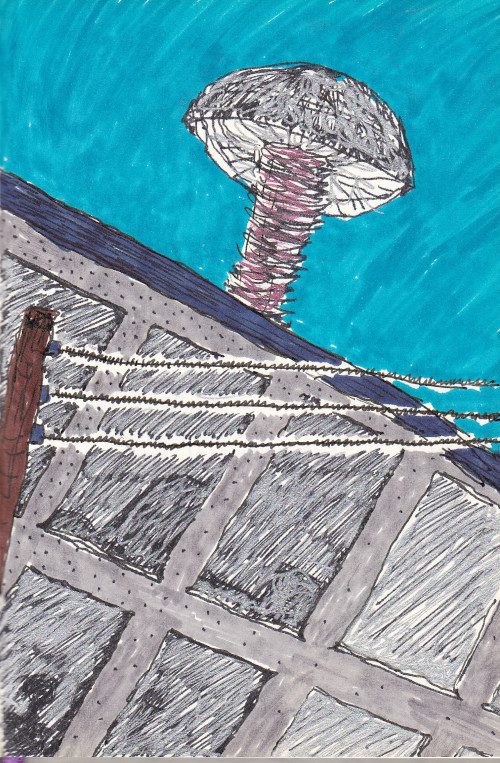
Looking up at a tall building on which was an inexplicable kind of mushroom sculpture. Suddenly the whole thing was snatched away by something invisible. It was jerked suddenly away and out of sight in a manner that felt violent, cruel, and sinister – because I could not see who or what had done this. In that moment of shocking, unexpected movement, there was nothing.
The strange “mushroom sculpture”. Sketch from notebook made shortly afterwards.
Fruitions come in all shapes and sizes, depending on the mind that hosts them. In minds like mine they are accompanied by visions; other minds seem capable of registering them in a more direct or abstract mode. It also seems possible to overlook fruitions altogether, noticing them only in retrospect by the effects left behind.
If we approach Daniel’s descriptions as templates rather than specific descriptions, then, of course, it increases the risk of identifying as a fruition experiences that might be nothing of the kind. On the other hand, it offers the possibility to refine and sharpen our observation of the minute details of experience.
Belief-shifting. A powerful magickal technique. Because by changing belief we change perception, and by changing perception reality changes, for what is reality other than perception?
Suppose everyone knew this. Suppose everyone, by choosing what to believe, could construct a reality.
Unfortunately, this is increasingly the world we inhabit. Aided and abetted by technology, reality is progressively more amenable to belief. Yet “magickal” is probably not the word to describe the current state of the world.
Using belief to create a new reality.
Belief is an echo of knowledge. Belief can reproduce a sense of certainty but none of the substance of knowledge. The difference between them is work: to gain knowledge we must do something. Knowledge implies a methodology. To know about Alaska we could read a book, ask an Alaskan, join a study group, or travel there to see. The more we do, the more and various types of knowledge we gain. Someone who knows something, even if it is false, can say how they came by that knowledge. Someone who believes, even if what they believe is true, is not telling you what they have found but what they hope to.
Belief is useful when we cannot do the work required to know. What is needed to do the work might be unavailable, or it might take time to obtain it or learn how to use it. Belief guides and focuses our effort, like a picture of a destination before we arrive. Belief is a motivation, not an end in itself. Later we might enjoy an opportunity to realise how our belief was wrong.
Knowledge and belief take forms that can make it hard to distinguish between them. The difference is not the true/false binary (because both belief and knowledge may be either false or true) but the amount of work done. In a digital culture we have lost capacity to appraise the analogue quantity of work that produces the material before us, as if each item somehow manifested from a uniform degree of effort.
Belief requires minimal effort whereas finding or making facts demands work. Belief-shifting is magickal because it seems to leap-frog work and jump directly to the experience of belief becoming reality. But beliefs do not come from nowhere. They are reflections of ideals. Not even a magickian can transform laziness into a virtue, because magick requires us to believe well. Any belief will produce effects, but the necessity for excellence in belief may only become apparent from unpleasant consequences.
That the needs of future generations are being sacrificed to the interests of an elite might not seem an unreasonable belief to many. But positing a paedophilic liberal conspiracy (Oluo 2016) will incur a different set of consequences. Likewise, it is perhaps not unreasonable to believe that unrestrained expression of opinions will cause actual harm, but believing it is rightful to ban the writings of J.K. Rowling because of views she has voiced elsewhere (Harrison 2020) leads down a different reality tunnel.
The Platonic ideals of goodness, truth, and beauty are universal. Ultimately, as rational animals, we all want the same, but we differ in our means of realising it. Knowledge is closer to truth than believing, but where we cannot do the work required to know then we must believe. Excellence in belief is striving to manifest to the highest degree the ideal in our belief. To be on the Left is to manifest an urge for freedom from what is regarded as bad. To be on the Right is to enact an impulse to maintain what is regarded as good. From the perspective of the ideal they amount to pretty much the same. The closer we align to the ideal, the less scope for division and conflict there will be.
Alignment with the ideal is the Great Work of Magick. “[T]he Science and Art of causing Change to occur in conformity with Will”, was how Crowley (2000: 126) famously defined magick, but he emphasised also the importance of discovering True Will – knowing what we truly want, which is by definition the ideal. Only by doing the work required to know True Will can we approach excellence in belief, which is how we manifest the ideal as best we can.
Magick can look like a quick and easy way to bend reality by shifting our beliefs. Post-modernism and digital communications have widely distributed the tools for doing this. We need not look far for examples of people doing it and where it has led them. Belief might seem to offer a convenient alternative to knowledge, but the dire consequences of this confusion are now endemic, and so too of the failure to believe well.
References
Crowley, Aleister (2000) Magick: Liber ABA Book Four. York Beach, ME: Weiser.
Harrison, Ellie (2020). JK Rowling: Hachette UK book staff told they are not allowed to boycott author over trans row. The Independent (17 June), https://tinyurl.com/y3u4kuxd (independent.co.uk, accessed January 2021).
Oluo, Ijeoma (2016). Pizzagate is a lie. But what it says about our society is real. The Guardian (5 December), https://tinyurl.com/zz7aqbd (theguardian.com, accessed January 2021).











 Occult Experiments in the Home